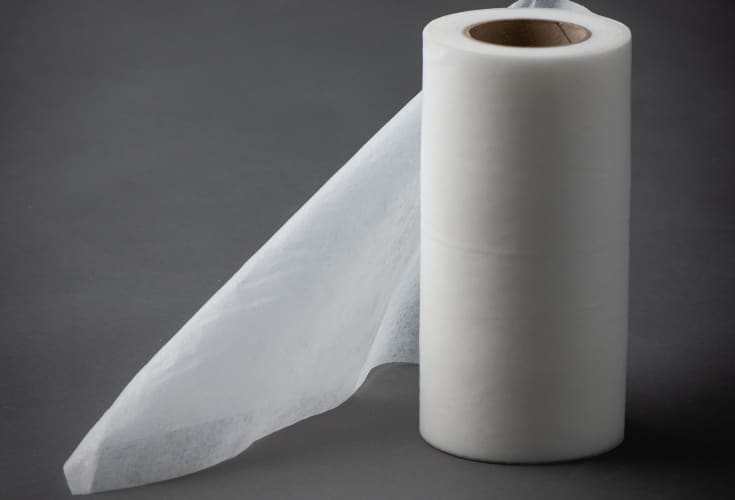
Confection of sanitary masks (FFP1) using our hotmelt non-woven fabric.
We’ve developed our own hotmelt hybrid non-woven technology. Here are the different requirements
to produce your own FFP1 masks using our products.
Materials you need :
- 2 layer of non-woven PP Spunbond
- 1 layer of hotmelt Copolyamide Hybrid Web of 50 gsm or more
- 2 rubberbands
Your production steps :
- Lamination of materials with warm cylinders
- HF welding and ironing of the edges
- Installation of the rubber bands
→ Get to know more about our hybrid range
The advantages of our hybrid :
- Current construction has been tested and approved as FFP1 masks by the end producer
- Good air permeability
- Water permeability proof (if no pressure involved) / splash-proof
- Very regular structure
- No air capsulation because of open structure
- Easy handling, stable when unrolling
- Mouldable, stretchable (or possible elastic), easy energy transfer
Protechnic Hybrid range :
- Available in Copolyester, Copolyamid, and TPU
- Available in width starting from 100mm to 2100mm (we can adapt to your needs)
- Available in roll length starting from 100 Lm to 500 Lm